Welcome
To
Robotics World

Saturday, 14 January 2017

Top 10 Best Robot Toys for Kids

1. ThinkGizmos Super Fun RC Robo Shooter

robot toys
When you first turn on the Robo Shooter by ThinkGizmos, he says, “Greetings Master. I await your command!” Immediately, it sends a jolt of excitement through your child. This kids robot comes with a remote control that’s easy to hold, and it allows the user to move the robot into position. Once in position, they’re able to shoot mini foam discs from its chest, taking out foes in its path. But he’s not just a shooting robot — he dances as well! He has a dance button that will send him into a dancing frenzy. He can walk in all directions, and he stands at 30 cm tall. He requires 6 AA batteries, but it’s well worth the battery burn, as your kids will absolutely adore their new robot friend.
Price: $35.00 (50 percent off MSRP)

Buy the ThinkGizmos Super Fun RC Robot here.


2. MiP Robot

There are quite a few great MiP Robots available by WowWee, but our favorite is the black MiP robot. It has a sort of “police the area” look to it, but what makes it unique is that it communicates using motions, sounds and RGB LED eyes. It balances on two wheels and scoots about the room its in with expert balance. This kid-friendly robot can also balance multiple objects, and has numerous modes including Roam, Stacking, Programming, and Dance. To activate these different modes, you simply turn the right wheel, and the big glowing LED on its chest changes color, meaning a new mode has been activated. We recommend trying the dancing mode first — something about robots and dancing always makes kids smile! There’s also an app that can be used as a remote. All around, the MiP Robot is one of the best gifts for boys and girls alike.
Price: $99.99

Buy the MiP Robot here.


3. Zoomer Dino

If you follow Heavy, you probably noticed that I’m a lover of dinosaur toys, and one of the best dino toys I frequently recommend is the Zoomer Dino. It was one of 2015’s best toys for boys, and now that it comes in at under $50, we love it even more! It comes with a super simple remote, which is a surprise since the dinosaur robot is so smart. In fact, like the MiP robot, he uses smart balancing technology to balance on two wheels. He can sense where you are and what you’re doing. He works on a charge, so you’ll only need batteries for the remote control (it takes three AAA batteries, so they’ll last for quite a while before you need to replace them). He even has a chomper button, as well as an angry button, which sends your dinosaur into a frenzy of fury.
Price: $46.89 (53 percent off MSRP)

Buy the Zoomer Dino here.


4. Meccano MeccaNoid G15

Some of the best moments I’ve had with my own son over the past year were when we were working together putting together his Meccano MeccaNoid G15. It comes with over 600 pieces, and some of them are rather small, which is why it’s recommended for ages 10+ (although, my 7 year old had no problem following the directions with a little help). This kit allows you to build your own personal robot, program him and play with him. The G15 was a hot commodity this past Christmas, and it has become a favorite choice for robot toys for kids.
Price: $90.99 (49 percent off MSRP)

Buy the Meccano MeccaNoid G15 here.


5. Sphero BB-8 App-Enabled Droid

The other big robot this past holiday season was the Sphero BB-8 App-enabled droid, which swept the nation of toy-lovers, and even made it on our list of the best BB-8 toys for sale. This little droid is controlled with your smartphone (works with both iOS and Android), and he’s able to listen to and respond, reacting to the voices around him. You can also record “holographic” videos and replay them later on. He’s undeniably charming, and your kids will have a blast controlling him with their phones.
Price: $136.98

Buy the Sphero BB-8 here.

Top 8 Best BB-8 Toys for Sale

From plushies to the coveted Sphero, these BB-8 toys make for perfect gifts this holiday season.
Click here to read more

6. Zoomer Kitty, Interactive Cat

Although not quite as advanced as the Zoomer Dino, there’s still plenty of room in our hearts for the Zoomer Kitty, an interactive robot cat toy that makes the “PURRfect” friend (their words, not mine). The cat plays with your children like a real cat would, and it even has touch sensors in its head, ears and cheeks. It’ll nuzzle your children just like a real cat would, and she’ll perform tricks. What’s more, she’ll follow her interactive kitty toy. She has a Cuddle Mode, Pounce Mode, and more, and she even sings and dances.
Price: $94.95 (5 percent off MSRP)

Buy the Zoomer Kitty here.


7. WowWee Robosapien Humanoid Toy Robot RC

A couple of years ago, one of the big hot toys of the year was the WowWee Robosapien, a humanoid robot brimming with personality (admittedly, PROGRAMMED personality, but still cool). He has fluid motions and gestures, and he has two speeds. He has four programming modes that allow him to do different things, like react to touch, pick up, kicks or sound. His hands grab, and his eyes light up. He can dance, and his moves are sure to make your kids laugh.
Price: $79.99 (11 percent off MSRP)

Buy the WowWee Robosapien Humanoid Toy Robot RC here.


8. OWI 14-in-1 Solar Robot Kit

cool robot toys
Solar energy is becoming ever important, and teaching your kids about solar energy and how to harness it is important. Believe it or not, robots can be used as educational toys, and one of our favorite learning tools is the OWI 14-in-1 Solar Robot Kit. It helps to teach children how to create solar powered robots, with two different levels of building skills. So whether they’re a beginner or an experienced crafter, there are plans in this kit that will keep them entertained. They’ll create various walking robots and robots that use wheels to get around, all of which are powered by the sun — that means no batteries required.
Price: $24.30 (38 percent off MSRP)

Buy the OWI 14-in-1 Solar Robot Kit here.


9. Combat Creatures Attacknid Doom Razor

Of course, it’s important to note that robots don’t have to be learning tools, either. In fact, some of the best robots for kids available right now come in the form of battle bots, just like this Attacknid Doom Razor by Combat Creatures. It’s a remote controlled robot that allows users to march over any terrain. It has a head that rotates a full 360 degrees to ensure that your robot never gets stuck. It has a 200 foot range and is controlled with a 2.4ghz remote. What’s more, battling this robot with a friend’s robot is an absolutely awesome experience. The battle bot can take damage (the legs pop off and on), and if the bot takes three hits to the electronic brain, it shuts down. It fires discs, and the battles can become pretty competitive.
Price: $283.95

Buy the Attacknid Doom Razor here.


10. Spy Gear Spy Video TRAKR

robots for kids
Kids love to spy on things, or at least, they love to think they’re spying on things. The Spy Gear Video TRAKR will allow them to do just that. It records live video and sends a feed directly to the controller. The camera has night vision, too, so they’ll be able use it to traverse the hallways late at night. It has an SD card slot to allow for the recording of videos (although it’s likely they won’t even use that feature). Admittedly, this spy robot has been around for a few years. However, that means there are tons of applications available for it, thanks to the fact that it uses C++ programming. Programs can be found online, and your kids will have a blast playing with it and getting their siblings into trouble for doing something they shouldn’t.
Price: $193.00

Tuesday, 3 January 2017

Farming with robots

Farmers are increasingly under pressure to feed more people. The UN predicts that the world population will rise from 7.3 billion today to 9.7 billion in 2050. This growing population has become pickier about the food they eat. In the EU alone, the organic market grew by 7.4% in 2014 with sales valued at €24 billion. Beyond organic food, there is an overall push to make farming greener by using less water and pesticides.
“Agriculture is most vulnerable to the impacts of climate change, but it’s also one of its causes”, says Birgit Schulz from Deepfield Robotics. “Making cultivation sustainable is essential”.
These factors mean farmers need to produce more, at a higher quality, and in a sustainable manner. With youth turning away from the profession, there is also less labour available to drive the vision forward.
Enter the robots — set to improve production yield, while reducing resources required, and making farming an exciting high-tech profession.
“Few people want to get up at 5am, farming is a heavy and dirty job.”, says Eldert van Henten, head of the the Farm Technology Group at Wageningen University in the Netherlands. He adds that, “the high-tech nature of future farming might attract new people into the profession, but also bring back those who left”.
Robots are just part of an overall push towards precision agriculture. Given the potential, Europe has funded at least 6 projects around robotic farming. And there is plenty to do given the large number of tasks on a farm that are ripe for automation.
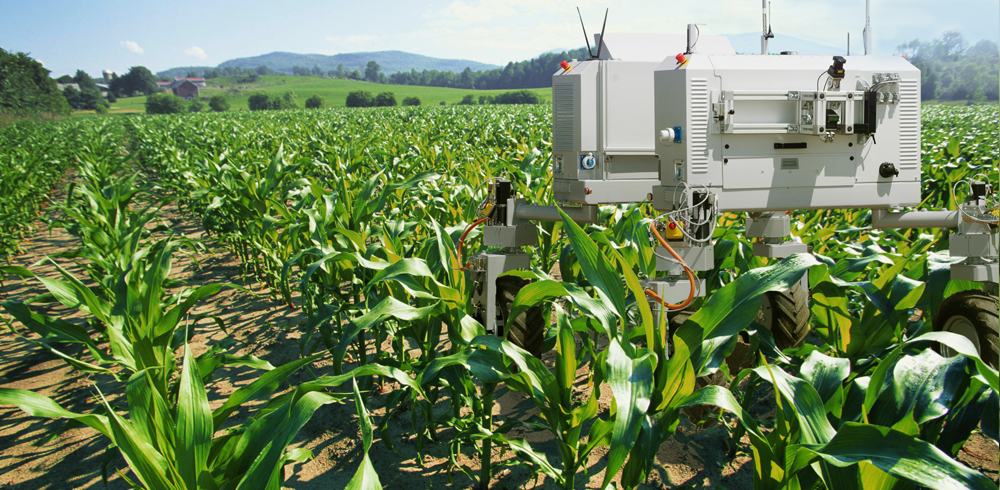
For crop farming, robots need to autonomously navigate their environment and perform actions at set locations, for example, picking a fruit, spraying a pesticide, planting a seed, imaging a plant, or making a measurement. Glasshouses are slightly simpler to move around since the environment is more carefully engineered, and is often fit with tracks which robots follow to reach desired locations. In the case of outdoor farming, the robots work by receiving a plan with a set of locations to visit on the field. When the robot trajectories are known, the robot can use GPS positioning and a closed-loop control to make sure it remains on track. When the task is to follow an unknown trajectory, for example a crop row, vision is often used to allow the robot to find its way. Robots are wirelessly connected to a central operator to both receive updated instructions regarding the mission, and report status and data. Put together, making an autonomous farm robot requires clever controllers, localisation and communication systems. To a certain extent, the technology is similar to that of autonomous cars applied to agtech. Where it differs is that farming robots often need to manipulate their environment, picking vegetables or fruits, applying pesticides in a localised manner, or planting seeds. All these tasks require sensing, manipulation, and processing of their own.
The recently finished project RHEA developed a fleet of tractors and aerial robots with sensor systems to discriminate weeds from crops and apply herbicides where needed. Pablo Gonzalez de Santos, the lead on the project, explains what is achievable today:
“Autonomous robots have already been demonstrated in many agricultural activities. Conventional tasks such as tilling, sowing, harvesting of grains, can be performed using autonomous robots with the accuracy provided by the vehicle itself (currently about ±2 cm when using GNSS technology). For other tasks that demand the use of vision to follow trajectories, the current accuracy is approximately ±7 cm.”
When it comes to using robots with intelligent tools, the achievements are promising.
“Autonomous tractors carrying herbicide sprayers coordinating with drones equipped with weed-detection systems have proven to save up to 75% of the herbicide. Autonomous tractors equipped with on-board weed detection systems are able to kill 90% of weeds on a field.”
Bosch startup ‘Deepfield Robotics’ also develops technologies for sustainable farming. “Our products are sensor networks and robots”, says Birgit Schulz.
Their robots navigate plant rows, sense the plants, and send the data to the farmers to help optimise seed breeding. If equipped with a “weed puncher”, the robot can literally drive weeds into the ground. Deepfield Robotics also provides smart sensors that can be positioned in the fields. Resulting networks are already deployed in farms to monitor soil conditions for asparagus.

Source: Deepfield Robotics

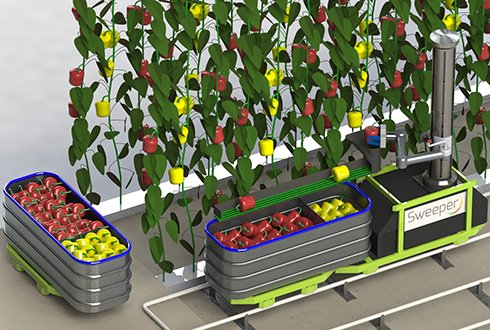
There are however many challenges ahead. Pablo Gonzalez de Santos says “Technical developments are required to identify fruits and analyse their degree of ripeness in harsh conditions (changing light conditions, presence of dust, extreme temperatures, wind variations), as well as to detect weeds. Robot position accuracy also has to be enhanced to help optimise pesticide applications and the precision of manipulation. Although industrial manipulators exhibit very good accuracy and speed in factories, their application in farming is more difficult due to the objects moving, being soft and delicate, and obstacle-rich environments.” Just imagine what it takes to pick a sweet pepper from a plant, compared to grabbing a bolt on an assembly line. As it turns out, sweet pepper harvesting is the subject of the recent Horizon2020 Sweeper project, which follows a previous EU project called Crops.
Eldert van Henten says, “It’s not just vision, tactile sensing would also be helpful to pick peppers out of a busy scene. Farmers definitely use touch. ”

Sweeper project.
Source: Sweeper project

And as is often the case in robotics, the lack of clear regulation is causing a headache for companies entering the field.
“Safety is an issue – robots have to be capable of detecting what is going on in their surroundings and act accordingly to protect humans, wildlife, and themselves from crashes and accidents”, says Pablo Gonzalez de Santos. He adds that, “it is completely unclear who carries responsibilities for injuries caused by autonomous ground robots. The legislation for drones is also restrictive, requiring special authorisations, even for research purposes. “
Birgit Schulz agrees that safety and regulation considerations are paramount and raises questions regarding how to “define and implement the right degree of autonomy for the robot” as well as a number of logistical considerations including “How does the robot get to the field? How can we make it easy to use the robot? What happens if a robot gets stuck?”
The good news is that farms are already open to new technologies being deployed and the investments that are required. You just need to look at some of their equipment to see the high-tech machinery in place. A little known fact: farms are already amongst the most prominent adopters of robotic technology.
Lely, which is based in the Netherlands, has a fleet of over 20,000 milking robots installed throughout the world. The Lely Astronaut A4 box allows cows to be milked when they choose so, instead of when the farmer needs it to be done. The robot attaches incoming cows to the teat cups, reattaches them if required, and detaches them after milking. As an added bonus, data about the cows is collected, which can help the farmer monitor the herd and take action should a problem arrive, or simply to improve yield.
The company also makes autonomous mobile robots that clean the barn, and automatically feed the cows with Juno and Vector.
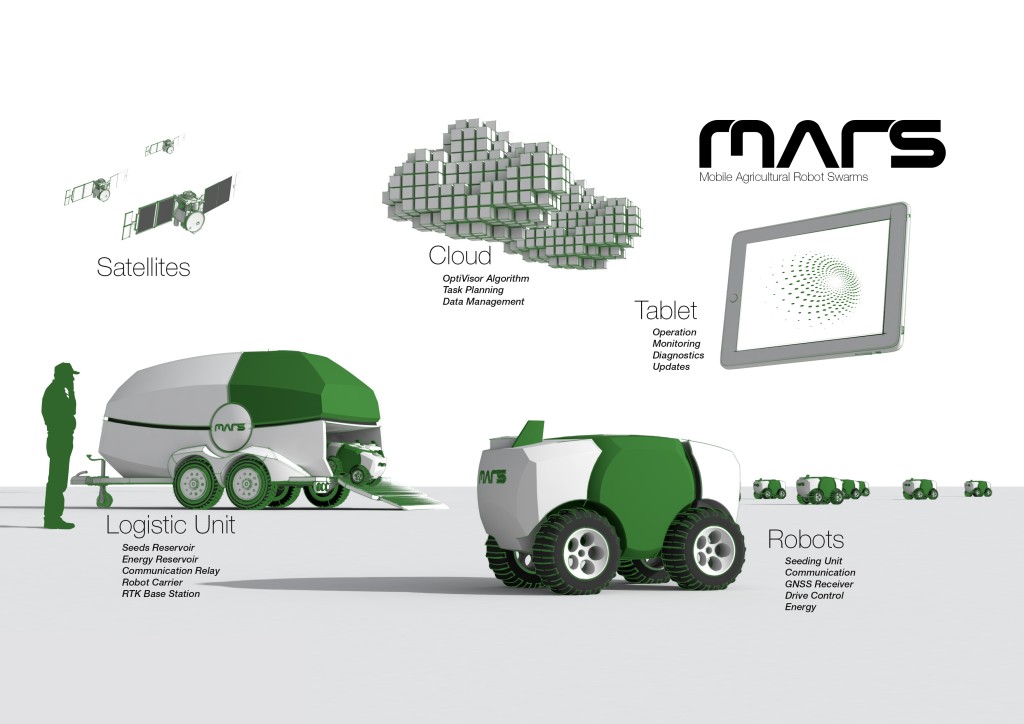
And the farm of tomorrow will include many robots working together. The MARS project, which stands for Mobile Agricultural Robot Swarms, demonstrated a cloud-based approach to farming at Hannover Messe last week. By deploying many simpler and smaller robots, they hope to make their farm-solutions safer, more reliable, and productive, while avoiding soil compaction that comes with larger robots navigating the fields. A swarm could also provide continuous operation, by having robots take turns charging or undergoing maintenance.

Source: MARS project

It’s an all around exciting time to deploy robots on farms, and there is a clear need to do so given the drive for increased food production, and sustainability. Steps are currently being made to develop the technology that will enable the automation of individual tasks before integration in a “digital farm” that will empower farmers to run operations in a fulfilling and efficient way. But there is still a lot of work to do. Eldert van Henten says robots will need to be “quick, precise, 100% successful, and cost-effective” before we can hope to see them on our farms. But, he adds, there is a “trend towards human-robot co-working. With one or more robots doing (part of) the job while being supervised, instructed by a human, or jointly working with a human. This might improve acceptance and feasibility of robotics technology for the more challenging tasks in agriculture”.

Monday, 2 January 2017

Meet Method-2, the real-life Avatar robot


Meet Method-2, the real-life Avatar robot

A giant South Korean-built manned robot that walks like a human but makes the ground shake under its weight has taken its first baby steps.
Designed by a veteran of science fiction blockbusters, the four-metre-tall (13-foot), 1.5 ton Method-2 towers over a room on the outskirts of Seoul.
The hulking human-like creation bears a striking resemblance to the military robots starring in the movie "Avatar".
It is claimed as a world first by its creators at Hankook Mirae Technology, a South Korean robotics company, where about 30 engineers were hard at work conducting initial tests Tuesday afternoon."Our robot is the world's first manned bipedal robot and is built to work in extreme hazardous areas where humans cannot go (unprotected)," said company chairman Yang Jin-Ho.
While its enormous size has grabbed media attention, the creators of Method-2 say the project's core achievement is the technology they developed and enhanced along the way.
"Everything we have been learning so far on this robot can be applied to solve real-world problems," said designer Vitaly Bulgarov on his Facebook page.
He has previously worked on film series such as Transformers, Robocop and Terminator.
A pilot sitting inside the robot's torso makes limb movements which are mimicked by Method-2, whose metal arms each weigh 130 kilograms (286 pounds).
The robot, more than twice the size of a tall man, is so heavy that it shakes the ground when it takes a step with a loud whirring of motors.
Yang, who dreamed as a child of building his own robot, said he has invested 242 billion won ($200 million) in the project since 2014 to "bring to life what only seemed possible in movies and cartoons".
Building the giant robot was a challenge for the engineers - most of them in their mid and late 30s - as its unprecedented scale meant they had nothing to refer to, said one who declined to be named.
So far, it remains unclear how the robot will be used. Method-2 is seen more as a test-bed for various technologies that will allow the creators to build any type and size of robot in future.
Yang said they have already received inquiries from industries ranging from manufacturing and construction to entertainment.
There have even been questions about its possible deployment along the heavily fortified Demilitarized Zone with North Korea.
But the robot, tethered by a power cable and still a bit wobbly on its feet, is far from finished. More work is needed on its balance and power systems, according to its creators.
"The robot is one year old so it is taking baby steps," Yang said.
"Just like humans, it will be able to move more freely in the next couple of years."
He said the robot will be ready for sale by the end of 2017 at a price of around 10 billion won ($8.3 million).

Popular Posts