Welcome
To
Robotics World

Tuesday, 6 December 2016

Designing a More Human-Like Lower Leg


Since bipedal robots took their first steps, the majority has been designed with the same basic joint/actuator configuration in their legs. This design, based on a simplified human leg, uses just six motors (three for the hip, one for the knee, and two for the ankle), and though it proved successful, it has also shown several limitations over the last 25 years. Now researchers at the Humanoid Robotics Institute at Waseda University (the birthplace of the first real humanoid robots) have set out to reinvent the wheel, er, the leg, by developing an entirely new shank that more closely replicates human walking.
The researchers, led by Professor Atsuo Takanishi, presented their groundbreaking work at the IEEE International Conference on Robotics and Automation (ICRA), early this month, in Germany. To design and test their new calf "muscles," the group started by taking a closer look at the legs of one of their robots: WABIAN-2R (WAseda BIpedal humANoid - No. 2 Refined) has been regarded as one of the world's most sophisticated humanoid robots since it was unveiled in 2006. It stands 148 cm (4 feet 10 inches) tall, weighs 64 kg (141 pounds), and, with its 41 degrees of freedom, can perform very human-like movements. What sets it apart from many other bipeds is its flexible pelvis, which gives it the ability to walk with stretched knees (unlike Honda's ASIMO, among others).
Most biped robots walk with flat feet that land parallel to the ground but WABIAN-2R's feet, with curving arch and flexible toes, lands heel-first and lifts off at its toes. That's progress, but a few vexing inconsistencies remain: humans walk with their feet roughly 90 mm (3.5 inches) apart, a distance doubled by the robot due to its large ankle motors. When walking, the robot's center of mass had a lateral movement of 50 mm (compared to just 30 mm for a human). And it couldn't mimic a person's foot rotation (approximately 12 degrees) due to a missing yaw joint in its ankle; a problem it and other biped robots inherited through the old joint configuration.
So with those limitations in sight, the Waseda researchers started working on their new leg. The missing foot rotation could come from the yaw axis in the hip, but that would also rotate the knee and just introduce its own set of problems. Instead, the researchers decided they would have to add a yaw joint somewhere below the knee, while at the same time shrinking the lower leg's overall size to shorten the step width between the feet. They began by looking at the average size and movement range found in humans, and analyzed motion-capture data to determine the optimal performance requirements of their new ankle.
In designing the prototype, the yaw rotation would be provided by a motor located at the top of the shin, just under the knee. The two motors normally situated in the ankle for pitch and roll were ditched in favor of a linear parallel link mechanism, which trimmed precious millimeters off the lower leg's circumference. Here is where they ran into their first major problem: there was no commercially available ball joint strong enough to withstand the compressive loads it would need to support. Their solution was to design one from scratch with the help of Japanese company Hephaist Seiko. (The project was supported in part by the Humanoid Robotics Institute, RoboSoM project, and Japan's MEXT.)
But the shank prototype's universal joints were causing problems and needed to be redesigned. Minor tweaks to the universal joints, and material changes, resulted in vastly improved stiffness and increased movable range. These and other refinements led to an entirely new system (pictured above, right). The researchers installed the new shank in their humanoid robot, which is now called WABIAN-2RIII.

This time, the robot worked marvelously. In experiments where it walked in place (see video above), not only was it able to match the human step time of 0.6 seconds, it also matched the required 12 degree foot rotation and 90 mm step width (see image below, right, showing the new design, and the one on the left, with the original robot, which had zero-degree foot rotation and 180 mm step width). The researchers have also successfully reduced its center of mass lateral movement from 50 mm down to 34 mm (just 4 mm shy of an actual human).
Next, the team plans on experimenting with forward walking, and reckon they can make adjustments to their existing walking pattern to achieve more realistic, human-like walking.

Sunday, 4 December 2016

The Robo-Doctor Will See You Now

The Robo-Doctor 
Will See You Now

The Robo-Doctor Will See You Now - Robotics
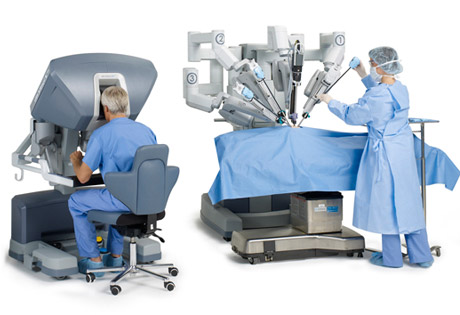
The da Vinci surgical robot. Image: Intuitive Surgical Systems
A technological idea born in science fiction is a promising answer to the challenging realities of modern health care.
With fewer doctors to meet the growing health-care needs of our aging population, hospitals and health systems are investing in robotic systems for surgery and telemedicine that increase their patient capacity and geographic reach. Machines like the da Vinci Surgical System (Intuitive Surgical Systems, Sunnyvale, CA) and the RP-7i Remote Presence medical robot (InTouch Health, Santa Barbara, CA) connect patients who need specialized care with physicians who can help them – even if they are an ocean apart.
In Robert A. Heinlein's popular 1942 science-fiction story "Waldo," a physically disabled but mechanically gifted man builds a set of automated "hands" that gave him super-human strength and dexterity. Waldo Farthingwaite-Jones could control his Synchronous Reduplicated Pantograph to duplicate his exact hand motions in numerous then-fictitious applications, including cellular-level microsurgery.
But fiction soon collided with reality when the nuclear industry invented a real gadget, nicknamed a Waldo, for the safe manipulation of radioactive materials from a remote location, and a new industry was born.
Seventy years later, medical robots are still an emerging technology. But forces such as health-care reform, the shortage of doctors and nurses, and the skyrocketing costs of hospital care are driving its acceptance like never before.

Robo-Surgeon

But it's about more than just saving money. Advocates of robotic surgery, for example, claim the da Vinci surgical robot achieves significantly better outcomes than either radiation or traditional surgery in delicate procedures such as radical prostatectomy for prostate cancer. They say robotic surgery can remove more cancerous tissue with less disruption of adjacent nerve endings than other methods, helping to reduce cancer recurrence and retain sexual function. That's why some 85% of men undergoing prostate cancer surgery are choosing medical centers that offer robotic surgery.
Introduced in 1999, the da Vinci system remains the standard robotic system for complex operations in cardiac, colorectal, gynecologic, thoracic, urologic, and head and neck surgeries. The U.S. Food & Drug Administration continues to approve its use in additional surgical applications.
"From Day One, when I sat down at that robotic console, I knew we would give patients a better outcome," said Florida surgeon Vipul Patel in a New York Times interview. "I have not seen anyone who has done a good amount of robotic surgery go back (to traditional methods)," he said.
The Robo-Doctor Will See You Now - Robotics
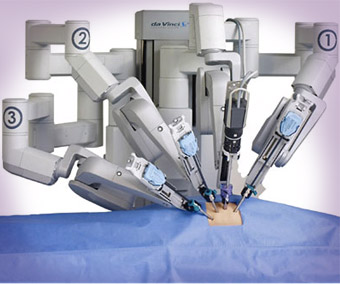
The robotic arms that comprise the da Vinci robot. 

Image: Intuitive Surgical Systems


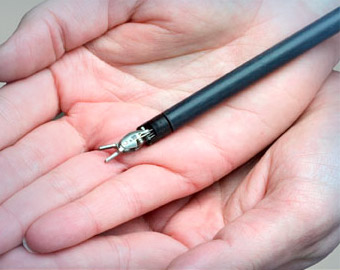
The guts of the system include four robotic arms, a high-definition 3-D viewing system with up to 10x magnification, and a novel family of specialized instruments with Intuitive Surgical's proprietary "EndoWrist" technology. Traditional devices such as forceps, scalpels, retractors, and suture drivers have been reimagined for the robotic age, with seven degrees of freedom, a large range of motion, and less risk from surgeon hand tremors.
The system's robotic and computer technologies work together to scale, filter, and translate the surgeon's hand movements into micro-movements that guide the instruments, not unlike the Waldo of science fiction. Seated at a viewing and control console located in or near the operating room, the surgeon uses hand controls to manipulate surgical instruments through tiny incisions. The instruments move like high-precision puppets with each motion of the surgeon's hand, wrist, or finger.
The Robo-Doctor Will See You Now - Robotics
Detail from the da Vinci robot.

Image: Intuitive Surgical Systems


Robotic surgery has its critics, especially among those concerned about its comparatively high cost and the worry that hospitals will over-hype the technology to lure patients and recoup their investments.
Catherine Mohr, director of medical research at Intuitive Surgical, acknowledged that a typical system "will cost you about as much as a solid gold surgeon. It's a fairly big capital investment, but once you've got it, your procedure costs do come down."


For Mohr, the next challenges in robotic surgery are to make the technique faster and easier to use in more complex operations, which is key to their eventual routine, cost-effective use. She said she is working with prototype designs that eliminate the need to move the robot to reach additional areas of the body and add new visualization capabilities that "see beyond the surface – we need to guide what we're cutting in a much better way."
University of Washington surgeon Dr. Richard Satava predicts in the next 40 to 50 years surgery will be completely automated. The surgeon's role will evolve to include management of a full information system built around the surgical environment. "The future of technology, and medicine in general, is not in blood and guts, but in bits and bytes," he says.

Robotic Hands Across the Water

The ultimate in robotic surgery would be the integration of daVinci-style surgical robots with telemedicine technologies that enable medical professionals to consult, assist, supervise, or train their counterparts in distant locations.
Intuitive Surgical says the daVinci is theoretically capable of long-distance surgery, but it's not the company's current focus. But in terms of experimentation, remote operations date back more than a decade.
The Robo-Doctor Will See You Now - Robotics
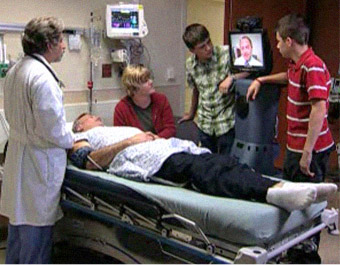
Patient being given a consultation via a bedside robot.

Image: InTouch Health


The first trans-Atlantic robotic surgery took place in September 2001, when teams of fiber-optically linked surgeons in New York and Strasbourg, France, robotically removed the gall bladder of a 68-year-old woman using robotic arms built by Computer Motion (later acquired by Intuitive Surgical). The robot's chief architect and inventor, Yulun Wang, later founded InTouch Health, maker of the RP-7i.


That technology may be more useful for surgeon training than for direct patient care, but there are myriad more routine applications today in which robots can not only improve patient care but also dramatically reduce its cost and increase its reach to remote communities. That's where the RP-7i comes in.
Remote presence robots bring big-city know-how to small-town clinics and trauma centers. The impact can be life-saving in the case of emergencies such as stroke or heart attack, where a fast diagnosis and onset of treatment is critical to saving heart or brain function. Telemedicine increases the public's access to advanced expertise while helping to reduce the overall cost of care. Critical care doctors in major trauma centers can evaluate accident victims remotely and, often, eliminate the need to transport them to larger hospitals.
The RP-7i system features one or more physician control stations linked wirelessly to what the company calls an "endpoint": a remote-controlled mobile console/medical cart topped by a high-definition video screen and camera. The robot enables two-way doctor-to-doctor and doctor-to-patient communication and visualization. It is equipped with a suite of basic medical instruments to allow remote monitoring of vital signs. The consulting doctor can observe patient behavior, check bedside monitors, confer with family members, or review medical images with the patient. Through his or her robotic counterpart, the remote physician can travel from room to room and to the nurses' station to review care plans.

Saturday, 3 December 2016

5 Robot Arms You Can Buy Soon

5 Robot Arms You Can Buy Soon

If you are interested in robotic arms for the Maker, educator, or small scale manufacturer, there is a lot to be excited about right now. Here are five choice robotic arms that may find their way onto your workspace soon.

Dobot

The Dobot robotic arm is already over 220% funded on Kickstarter with lots of time to spare.
Dobot four axis Arduino-based robotic arm.
Dobot four axis Arduino-based robotic arm
Dobot is a four axis robotic arm designed for Makers, artists, educators, and scientists. The high quality aluminum frame provides stability and the Arduino-controlled stepper motors provide precision and accuracy.
The arm can be controlled with Bluetooth via a smartphone app or PC. There is a control rig to allow Dobot to follow the motion of your hand, and it can recognize objects via a web camera.
In addition to a gripper, the Dobot has multiple heads for different types of operation, including laser engraving. That’s hot!
Video Player
00:00
02:37

7Bot

Another robotic arm tearing up Kickstarter right now is 7Bot. They funded in four days and have already nearly doubled their goal. They still have plenty of time left if you want to get in on it.
7Bot six axis robotic arm.
7Bot’s six axis aluminum frame and custom high torque steel gear 24W servos make for an impressively robust and stable platform. The servos provide positional feedback with 0.18 degree accuracy. It is available with options for a vacuum cup gripper or a two finger gripper.
7Bot is designed to be easy to use. You can train it by physically guiding it; their Kickstarter page brags that the grandfather of one of the creators taught 7Bot Chinese calligraphy. You can use computer vision to have 7Bot follow and copy your movements. It can be programmed to sort objects by color. There is also a 3D model UI for programming and an API for more advanced control.
Video Player
00:00
03:50

FLX.ARM from Flux Integration

Flux Integration has been working on a robotic arm to fill what they see as an important niche in the market. It’s the space between low quality “toy” robotic arms and high cost manufacturing and research arms that cost $10,000 or more.
The FLX.ARM precision robotic arm by Flux Integration.
Their solution is the FLX.ARM low cost precision robotic arm, which can do 3D printing, milling, and electronics assembly. They successful funded their Kickstarter campaign last October, and have been working ever since refining their design and preparing for production.
FLX.ARM is the robot arm itself. The solution also includes the FLX.IDE development environment and the FLX.CTL control hardware.
An interesting feature is the auto tool change. Different tool heads are stored on a special rack, and the arm can be programmed to swap between tools during operation.
Video Player
00:00
03:47

Makerarm

Makerarm is a pretty ambitious concept. One robotic platform that can be configured to 3D print, laser cut and engrave, carve and mill, write and plot, perform PCB fabrication and assembly, cut stencils, pick and place, assemble, or whatever else you can dream up.
Makerarm personal fabrication system.
Makerarm personal fabrication system
Makerarm is intended to be a “personal fabrication system” that can mount to your desktop. Interchangeable tool heads let you swap between functions. One arm that can perform many functions is a great concept. Their design looks beautifully executed, although many details are lacking thus far.
Despite the small base footprint, the arm has a 30″ reach and a 10″ working height. The system features auto-levelling so it can work with any flat surface. You can even control Makerarm wirelessly.
Makerarm was founded by Zaib Husain, who has two other technology startups under her belt.
The product is in private beta testing now. You can submit your email on their website to request a free trial.
If Makerarm works half as well as it looks, it will be very impressive.

Evil Minion Robot Arm from Marginally Clever

Dan Royer, President of Marginally Clever, believes the human race is fated to leave the planet Earth. In fact he wants to develop automated factories on the Moon. For this to happen we must, Royer says on his blog, “make low cost, high quality robotic arms that can assemble each other.”
royer arm
Marginally Clever’s Arm Kit
And so Marginally Clever has a goal to design educational robot arms that are open source and open hardware, and make them available so we can all help towards the mission of developing automated robot factories.
His website sells a three axis robot arm kit like the one pictured to the right, but he also has the “Evil Minion” five axis robot arm, which he recently displayed at the TELUS World of Science in Vancouver. Royer’s purple minion is a test bed for new designs.
He frequently posts pictures of his work on Instagram. You can follow him there @imakerobots. Below you can see a new gripper that has been developed.
Royer will be at World Maker Faire in New York this September with a giant LED wall, and of course, his Evil Minion.
Dan's Evil Minion now has... The Claw!
Royer’s Evil Minion now has… The Claw!

Popular Posts